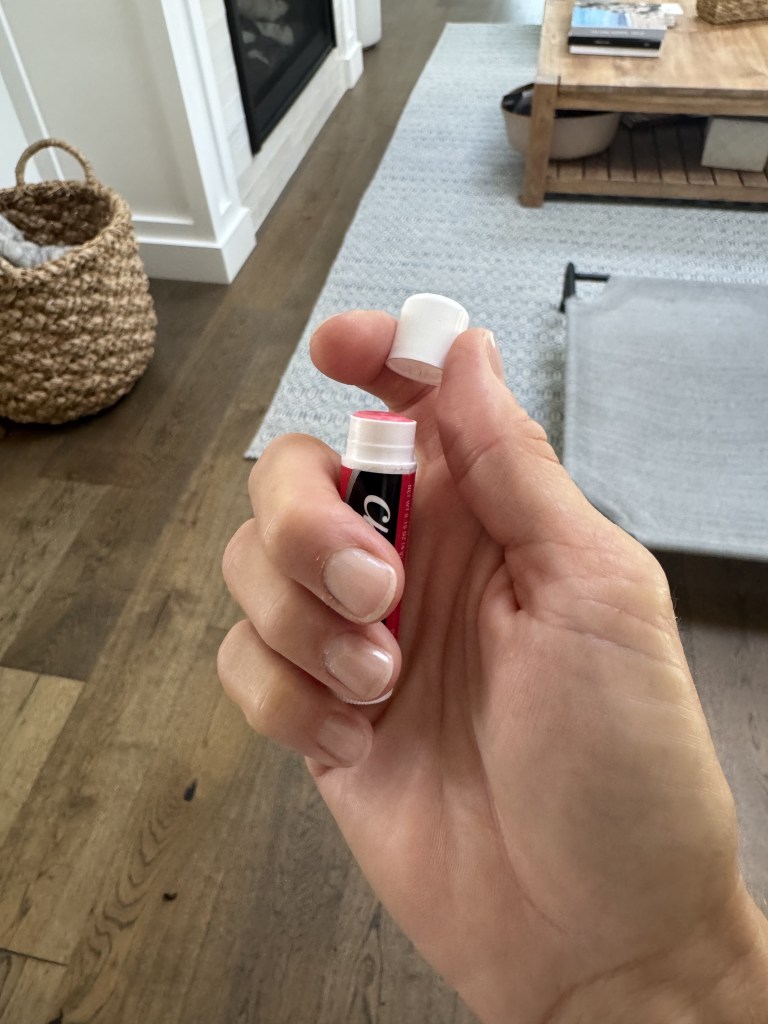
I had a very impressive move in which I, with a single hand, would swiftly grab my chapstick from my pocket, remove the lid, slather my lips, replace the lid and tuck it away again, without even thinking about it. That is because I always carried chapstick in my pocket and had developed great efficiency due to my habitual use. Lips get dry, you know? And they feel so darn good when they’re all slicked up with petroleum products.
Those chapsticks had such a sense of belonging that I hardly noticed their presence when getting undressed and throwing my clothes in the hamper. And so, it was with great frequency that I would find them in the wash, soggy but salvageable, and with even greater frequency that I would find them in the dryer, melted beyond recognition.
This happened for longer than I’d like to admit when I realized that this wasn’t working for me. Something needed to change. I felt like such a grownup when I began to check my pockets before putting them in the hamper. Brilliant! Except I didn’t always remember and rogue chapsticks still turned up in the wash. I took it a step further by checking pockets as I was loading the washer, reasoning that this would be more comprehensive and, thus, fail proof. Except it wasn’t. I was baffled.
My genius moment came out of the blue one day. I excitedly blurted out to Chase, “What if I don’t put chapstick in my pockets at all??” It felt inspired. And I think it was, because it has been many months, maybe even a year, since my chapstick has surfaced anywhere but my purse or bathroom drawer. The greatest surprise is that my lips are just fine with a couple applications, rather than a dozen or more, each day. Who knew?
This is a silly example but it does, I think, point to a bigger truth. Sometimes we have such well-established habits and familiar patterns that we don’t even recognize when something isn’t serving us well. It’s just the way it is, we may think. So we keep doing the same things, getting the same results and probably aren’t even surprised about it because it is normal from our vantage point. Or maybe we see the problem but have accepted its presence because we can’t see an alternative.
The potential for change begins with insight and honesty. The first is a gift from above. We can’t see what we are blind to until our eyes have been opened. I believe this “opening” always comes by way of the Holy Spirit, although it is sometimes delivered through a trusted friend or family member who can see what we can’t. The reason it is such a gift, even though it usually creates discomfort, is that change never happens without first identifying a problem. As they say, “If it ain’t broke, don’t fix it.”
The second – honesty – is a vulnerable and courageous response to that gift. It is easy to justify our behaviors or lean on our good intentions. It is also easy to hide behind the shame and judgment we might feel over our struggle or weakness. But both of these responses hinder the humility and curiosity required to seek the Lord for a new way. It is only as we are acknowledging our brokenness without judgment or justification that we are then able to ask him, “What now?”
That’s when the magic happens. Sometimes there is an instant lightbulb moment as a solution emerges, often delightfully creative or surprising. Or just plain simple, like “how did I not think of this sooner?” Sometimes we have to wait a while, keeping our ears open for the next step. Other times it is a years-long process as we walk in relationship with the Lord who is often working to shift our foundations, like the beliefs motivating our behaviors rather than just fixing the behavior itself. One way he works, at least in my life, is to let me try to solve the problem.. and fail repeatedly… until I finally realize it is above my pay grade and the only reasonable choice is to humble myself and hand it to him. Then, as in my last post, I find myself suddenly able to make choices I couldn’t before. Not only does it feel miraculous (because it is), but it increases trust, decreases the striving that comes from trying to fix myself and deepens my understanding of how loved I am, even with all of my faults and flaws.
Please know, I am in no way suggesting a witch hunt for problems, but I do think we would benefit greatly from asking, as Paul did in Ephesians, for God to open the eyes of our heart. Or, as David did in Psalm 139, “Search me, God, and know my heart; test me and know my anxious thoughts. See if there is any offensive way in me, and lead me in the way everlasting.”
Note: I recently came across a wonderful resource in the form of Dr. Lee Warren who bridges neuroscience and faith to help people move forward. He has many free videos and podcasts, and has also written several books (I just finished and enjoyed The Art of Self Brain Surgery).


Leave a Reply