Posted by: Kara Luker | July 21, 2011

Oreos and love

Jesus replied: “‘Love the Lord your God with all your heart and with all your soul and with all your mind.’ This is the first and greatest commandment. And the second is like it: ‘Love your neighbor as yourself.’”Matthew 22:37-39

I wanted to expound on my last post but it was late and, since I had wake up at o-dark-thirty to get Cole to sailing lessons before work, I posted what I had and drifted into dreamless slumber on my striped pillow. What I shared I believe to be very true, but there is more.

Focusing on the truth about ourselves is like one side of an Oreo; tasty but incomplete. Focusing on the truth about others is like the other side; still tasty but still incomplete. What really sets an Oreo apart and holds everything together is that mysterious white stuff in the middle. Let’s pretend for the moment that the mystery has nothing to do with lard, but with recognizing the authority of God.

As discussed in the last post, we are called to fix our eyes on what is real (what God says about us) rather than on what is counterfeit (what we, others, or the enemy say about us). Our shortcomings do not change our identity or God’s view of us, ever. Who we are is fact, as established by the Creator himself. As this becomes our focus, our lives will naturally reflect it.

God didn’t just create us with a true identity, but he did the same for all his people. So we, as loved individuals (see previous paragraph), are called out of our natural understanding of the people around us and into a supernatural understanding. “How does such a thing occur?,” you may ask. Once again, it is by focusing on their value (what God says is true) rather than on their shortcomings (what we perceive to be true). What will naturally follow is that our hearts will see beyond behavior and love others for real.

As you may already have realized, we can’t stand firm in any of this if we haven’t recognized God’s authority. So, really, our first step is to fix our eyes on what he has said about himself and let the purity of that truth corrode every shadow, doubt, and accusation we have against his character. If ever there was solid ground on which to stand, this is it. It also happens to be the tasty mystery that holds everything else in its place.

Posted by: Kara Luker | July 19, 2011

Whatever is true

Finally, brothers, whatever is true, whatever is noble, whatever is right, whatever is pure, whatever is lovely, whatever is admirable–if anything is excellent or praiseworthy–think about such things. Philippians 4:8

I remember being told that when bank tellers are trained, they become so intimately familiar with the feel of real currency through the intentional handling of legit bills that they are able to recognize the feel of a counterfeit bill. I have no idea if this is true, but it’s a great example. If you think about it, there are many ways and materials by which fake money can be produced and it would follow that each would feel slightly different. Yet there is one way to produce the real thing and every bill will always be the same. So it makes sense that the surest way to identify the countless things that don’t belong is to recognize what does belong.

A friend and I have both struggled with self-condemnation and perfectionism, wanting so desperately to please God and feeling a persistent sense of failure. We have both come far, but not to the point of the issue being found only in our personal history books. During a prayer time together today, the above verse came to mind, expanded in my heart, and became so suddenly clear to me.

We were never called to focus on our sin. To acknowledge it, yes. To receive forgiveness and turn from it, absolutely. But to fix our eyes there is like trying to learn every single form of counterfeit money. There will never be an end because it will always pop up in some new form. Talk about an overwhelming task and persistent sense of failure.

Instead, we were called to focus on what God says is true about us. It is simple, genuine, and unchanging. As we set our minds to the intentional handling of the truth based on the authority of God himself, we will be able to recognize it as authentic. It will become so familiar, that any thought or action that is not from our new nature will be exposed for the counterfeit it is. Not only will we learn to reject it, but will become so confident that we call the cops and have the lie hauled in. Best of all, there will be joy because we are becoming people who recognize the truth and know our value.

Posted by: Kara Luker | July 17, 2011

A harmonious crew

Iron sharpens iron, and one man sharpens another. Proverbs 27:17

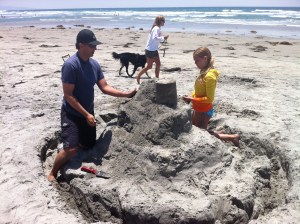
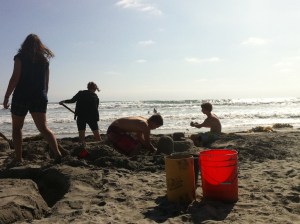
Last weekend, we went camping at San Elijo State Beach with my cousin’s family and a bunch of other great people. While sitting on the sand watching the clouds roll by and the kids play on their big blue Costco surfboards, my boyfriend, John, decided it was time to build a sand castle. A big one. He had prepared for the occasion by bringing a large metal shovel of the Home Depot – not sand toy – variety, and various other tools for the job. His growing mound of sand and noble mote soon received the architectural touch of his daughter, Madison. And then me. Then Alyssa and Hannah. And Aubrey. And the twins. Oh, and the teenage boys. And so it went until the end of the day when the stretch of beach before us revealed several large sand castles of diverse design connected by an intricate system of motes. It was dazzling.

The next day, the beach – which was previously barren besides our global sand village – was strewn with sand creations of every variety… inspired, perhaps, by what we had built the day before, but unique to the imaginations of the kids (and adults) constructing them. Our group added another large castle, which bore a strong resemblance to a California mission and was given an A+ by a passing fourth grade teacher. But there was no way to compare each design and no desire to compete. We were all just very joyfully working to make our own wonderful thing and, I think, to be a part of something bigger.

Each day ended with a bit of sunburn and a sense of accomplishment. Even though the castles were destroyed by rascally kids and the incoming tide, there was something lasting formed in the process. Something of camaraderie and unity. Imaginations getting sparked. Memories being created. Everyone coming together to make something so much better than it would have been alone. I know this translates to much bigger life things, but I think it will also translate to even better castles. In fact, Cole and I are looking forward to the next beach day when we aspire to build a Mayan temple… with the willing and able hands and minds of our harmonious crew, of course… and can’t wait to see what great things the people around us construct from big imaginations and tiny grains of sand.


Posted by: Kara Luker | June 19, 2011

Oh, to be still

Be still and know that I am God.  Psalm 46:10 

When my boss and I called in for our organization’s corporate prayer time on Friday, we didn’t hear the usual passage of scripture, followed by praise reports and prayer with our small group. Instead, we were read a brief quote on the importance of learning to be quiet and listen to God (or something of that sort; truth be told, I wasn’t altogether listening). We were then told to spend the next 25 minutes in silence. Just as I was thinking I could easily do that while working, Jesse’s voice came from the speaker saying, “Do not go back to work.” “Find a quiet place and listen.” Oh, okay. I get it.

It took me and my boss great restraint to keep from discussing this assignment before actually doing it, holding our lips together really tight like fidgety kindergarteners trying to be good. But we managed and I happily set out to my favorite walking path. Gorgeous day. Birds singing. Peaceful, as always. This assignment was right up my alley, and no doubt one I would ace. But, as it turns out, I suck at being quiet.

I finally got my mouth to stop, mostly. But my mind wouldn’t quit. It was like one of those awful mechanical dogs that bark incessantly when you walk by a toy store. I’d turn off one thought, only to find ten more noisy things yapping at me and demanding my attention. I persisted in the exercise and even extended the walk a bit to give a chance for better mastery, but still ended up back at work feeling quiet on the outside and noisy on the inside.

But as the day wore on, I noticed that my body was more relaxed. And my mind seemed calmer. The things I was sure I had to figure out before getting quiet lost their urgency and fell off my horizon. When I got in my car at the end of the day, I found a stillness I had forgotten existed. There was no desire to save the universe through my mental analyses, distract myself with music or sermons, or even pray with words like I’m used to. I just was. And God was. And we were. It was divine.

It is interesting to me how opposite this is of my life in general. Busy. Noisy. Distracted. Controlled. I don’t mean it to be that way. I’m mostly trying to make the most of what God has given me and what he has put in my heart to do, but things keep getting out of balance and I know it. When I follow the maze back to the start, I always find the same thing: Self-importance. Maybe you’d call it pride.

Instead of letting God figure something out and tell me what to do, I butt in and want to help him figure it out like some obnoxious micromanager. Instead of asking God which people (and when) he wants me to be available for, I want to help everyone all the time and sometimes think – with ridiculous self-righteousness – that they won’t be okay without me. As if I’m the savior of myself or my son or my friends. Getting quiet on Friday reminded me that He alone saves. He alone has the answers. He alone is wise.

He won’t give me more than I can accomplish. Not only that, but he won’t give me more than I can accomplish in perfect peace. As it says in Isaiah, “This is what the Sovereign LORD, the Holy One of Israel, says: “Only in returning to me and resting in me will you be saved. In quietness and confidence is your strength.” If I trust God more than I trust myself, I will lay down my thoughts, my agenda, and the ways I seek to affirm myself. I will take the time to hear what is on his heart and what is important to him. I will be refreshed and gain perspective. I will indeed be still and know that he is God.

Cease striving and know that I am God. Psalm 46:10 NASB

Let go [of your concerns]! Then you will know that I am God. Psalm 46:10 Amp

Be at peace in the knowledge that I am God. Psalm 46:10 BBE

Barnes’ Notes on the Bible

Be still – The word used here means properly to cast down; to let fall; to let hang down; then, to be relaxed, slackened, especially the hands: It is also employed in the sense of not making an effort; not putting forth exertion; and then would express the idea of leaving matters with God, or of being without anxiety about the issue. Compare Exodus 14:13, “Stand still, and see the salvation of God.” In this place the word seems to be used as meaning that there was to be no anxiety; that there was to be a calm, confiding, trustful state of mind in view of the displays of the divine presence and power. The mind was to be calm, in view of the fact that God had interposed, and had shown that he was able to defend his people when surrounded by dangers. If this the divine interposition when Jerusalem was threatened by the armies of the Assyrians under Sennacherib, the force and beauty of the expression will be most clearly seen.

Posted by: Kara Luker | June 14, 2011

Parking places and suffering

And God placed all things under his feet and appointed him to be head over everything for the church,  which is his body, the fullness of him who fills everything in every way. Ephesians 1:22-23

A while back someone asked me what kind of God would care about something so insignificant as helping someone find a parking place on a crowded day at the beach or a lost wallet at the mall, while neglecting the cries of a suffering world. It was a good question. There are oodles of other unbelievers – and believers – with the same doubts, who question God’s character or refrain from asking him any questions they deem unworthy of his time and efforts.

I didn’t have an immediate answer to his question, but found an understanding floating through my head later that day. My mom would give her life for me. There is no question in my mind. She has never had the opportunity to prove this, so how can I be so certain? Because she has demonstrated her care for me. Sometimes in small ways, like speaking kind words or helping me find something I’ve lost. Sometimes in bigger ways, like foregoing sleep to talk me through a hard place or loving me when I am as approachable as a man-of-war. Many of my crises have been pretty unimportant in the big scheme of things, but they have mattered to her because of her concern and compassion for me. I have become so assured of her love that I can stand confidently in it and can trust her with all I am for much greater things.

If we care for our children in these ways, how much more does our Father, who has a far truer love than we do – a perfect love, in fact – care for us? While a lost wallet is not a life or death problem, it’s an opportunity to demonstrate his care for the kids he loves. And while a parking space might not particularly matter to him, we do. As we see his provision in small ways and come to know his kindness, we learn to trust him in big ways and are able to act with authority on the things he’s promised. We also begin to realize that he did lay down his life for us in the ultimate act of love, and can understand more intimately what it took to do such a thing for us ragamuffins who couldn’t yet begin to grasp the significance.

The breakdown often comes with how this translates in our lives. Maybe we don’t learn to trust him for small things and are then unable to look to him for bigger things. Maybe, instead of asking him to meet our needs, we decide what is worthy of his attention. Or maybe we receive his love, wrap it up around us like a down comforter, and snuggle up in the fluffy warmth for a long winter’s nap. But his love is raw, pulsing life that was never meant to stop with us. It has no boundaries. Not of “small” or “big” or “relative to other people’s problems.” Not of a need or person or household or community or nation. It flows freely to the ends of the earth and back again.

On Sunday, in the middle of a challenging and powerful message, my pastor made this statement: “God fills Jesus. Jesus fills the church. The church fills the world, revealing the presence of God in it.” We are the body of Christ. We were given his kindness not only because of his love for us, but because of his love for all the world. Yes, it’s a broken world, and there is hunger, sickness, and pain.  But we are here, as the hands and feet of a loving God, to feed the hungry, heal the sick, and comfort the hurting. Can each of us meet every need? No way, no how. Can each of us be one part of the body, working together to show this broken world what love looks like? Heck yeah!

So here is my confession. I have been stuffed full with the nourishment of God, grown plump in his goodness, and slept soundly in my fatness while others have gone hungry. I’m still a bit groggy with sleep in my eyes, but am starting to wake up to the very exciting truth that God made me because he needs me. He made you because he needs you. He knit us together in love, not so we could be some tight clique that self-centeredly rejoices in its position, but to declare the love of God to a world in need. So that they might be knit together with us, and proclaim with all their hearts the great love of the God who drew them in through the kindness of his people.

Posted by: Kara Luker | June 10, 2011

Boundless freedom

Anyone who believes in me may come and drink! For the Scriptures declare, “Rivers of living water will flow from his heart.” John 7:38 NLT

Life in the Spirit

A couple weeks ago at my work retreat in Pennsylvania, I was sitting in a session on discipleship in organizations being given by Ate Ruth, a brilliant Filipino woman. Seemingly unrelated to the information being presented, I suddenly saw in my mind’s eye a fast-moving river. It was so real, I could almost hear the sound of rushing water and feel its cold spray on my face. I knew in my heart that this mighty river was the Holy Spirit, who moves freely and powerfully in the will of God. I also recognized it as the same boundless purpose and freedom we have in him.

I think it’s no coincidence that the Lord showed me on my flight to Pennsylvania the way his love obliterates boundaries. And that I would see this river picture, which turned out to be so closely connected, while learning from Ate Ruth the importance of God’s order and ways in every area of life.

Anyone who has read this blog for any length of time knows that I have had to wrestle to the ground my wants, expectations, and understanding. It’s not because they’re necessarily bad, but because they conflict with what God has said. Resenting someone for hurting my son conflicts with the command to “Forgive as the Lord forgave you.” Walking in fear or anxiety conflicts with the scripture, “The Lord is my helper; I will not fear.” Getting frustrated when my circumstances turn south or when people fail me conflicts with Paul’s exhortation to “Rejoice in the Lord always.” The list could go on for days, but you get the idea.

Anyone who believes in Jesus will have rivers of living water flowing from his heart. This living water comes from the Spirit of God who lives in us… the very same Spirit who raised Jesus from the dead. What a staggering statement. Healing of mind or body is nothing to the Holy Spirit. Victory over sin is nothing to the Holy Spirit. His power exceeds our need. His wild river was loosed to empower us when Jesus, who said we will do even greater things than he did, went to the Father.  And yet, however true this is, most of us are unable to relate to that kind of resurrection power in our lives. We relate far more to our own limitations and inability to live as we are called to live.

The problem is not that we don’t have the power that we need to live an abundant, victorious life; it is that we have diverted the flow of the river. This mighty Spirit wants to move freely through our minds, bodies, hearts, words, actions – our whole being – but we have built up walls in our minds and hearts through our insistence of doing things our own way, our resistance to surrender, and our refusal to accept his kingship over our lives. As we yield to the ways that he has laid out for us and the truth he has spoken, the damns that are holding back his resurrection life will begin to leak, then break apart, then be completely destroyed.

The very good news is that the Spirit is so powerful, even a trickle is enough to eat away at the things that keep us from true life. Which enables more of the Spirit to flow. Which empowers us to surrender more of our own understanding. Which enables more of the Spirit to flow. And so it goes until the end of this age. So drink of his Spirit, be encouraged, and actively anticipate the great things to come and those that are here even now.

Posted by: Kara Luker | June 9, 2011

A journey worth taking

He was confidently looking forward to a city with eternal foundations, a city designed and built by God. Hebrews 11:10 NLT

In The Horse and His Boy (my favorite Chronicle of Narnia), there is a boy named Shasta who has always felt drawn, almost to the point of longing, to know what lies north of his small seaside village and equally small existence. He doesn’t know why his curiosity is bent in that direction, but his father dismisses his questions and the boy doesn’t really think too far beyond that. The reader quickly learns the reason for his interest. The north is where he is from; he is simply being drawn back to the rock from which he was hewn.

We are Shasta. Inside each one of us is a longing to return to the place we came from and, in so doing, to become who we truly are and what we were always meant to be. Most of us would like to instantaneously arrive at that place and become that person, but fail to realize that it is the Spirit of the journey that will transform us into our true selves, preparing us to live in our native land and empowering us to accomplish things of eternal worth.

It’s the very reason we are drawn to stories of great romance or conquest in which obstacles are overcome, character is proven, and darkness defeated by light. They call to something of truth inside. It’s not enough, though, to watch movies or read books of struggle birthing significance. We were created to be in the story; to live significance. Because the purity of heaven is our native land, the noble cause of love is in our blood, and the courage required is our inheritance.

But, like Shasta or any character worth reading about, we have to traverse difficult ground and face troublesome things to get anywhere worth going. That can be so easily mistaken for the wrong road or one not worth the trouble. So we turn around and go back to what we know, maybe with a sense of relief, one of defeat, or perhaps a bit of numbness to true longing.

We were not made to be landlubbers, clinging to the familiar cultivated ground we have become so accustomed to. We were made to become master navigators of all terrain, able to quickly and adeptly go wherever God has called us to go. But we won’t become skilled sailors by sticking our toes in the edge of the sea or emboldened mountain climbers by gazing up at the heights. It is only in the journey – particularly the difficult parts – that we develop the necessary skill and strength required for mastery.

In other words, if you are in a boat with mounting waves and trembling knees, this is a good thing. Not because God wants to see you drown or head back to shore as quickly as your puny boat can get you there. But because he wants you to learn how to navigate the waves, so that they will never, ever be able to cause you fear or doubt again. He wants to set you free from the boundaries of your current existence, so that you can return to the land your heart longs for.

He is a good teacher, and a patient one. Even if you have jumped ship and swam to shore 100 times, he will lovingly take you back out to sea and show you the way through the storm. It is through this journey, and the relationship forged, that you will become who you truly are and what you were always meant to be.

Posted by: Kara Luker | June 8, 2011

The little and the much

I was writing this blog in my head yesterday morning while half – or mostly – asleep on a ridiculously comfortable pillow for an indulgent eternity. This delicious experience was cut unpleasantly short by the realization that I hadn’t set my alarm and was an hour late for work. So I gave my reflection, pillow, and anticipated shower a sad farewell and head off for a long, but fulfilling day.
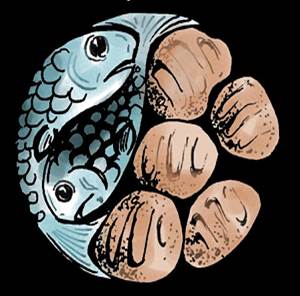
The sweetness of the post, which may have had more to do with the fact that it was probably a dream, seems to have diminished, but I’m going to share it anyway. It had to do with that boy in the John 6 story of the fish and the loaves:

5 When Jesus looked up and saw a great
crowd coming toward him, he said to Philip, “Where shall we buy bread for these
people to eat?” 6 He asked this only to test him,
for he already had in mind what he was going to do.

7 Philip answered him,
“It would take more than half a year’s wages[a] to buy enough bread for each one to have a
bite!”

8 Another of his
disciples, Andrew, Simon Peter’s brother, spoke up, 9
“Here is a boy with five small barley loaves and two small fish, but how far
will they go among so many?”

10 Jesus said, “Have the
people sit down.” There was plenty of grass in that place, and they sat down
(about five thousand men were there). 11 Jesus then
took the loaves, gave thanks, and distributed to those who were seated as much
as they wanted. He did the same with the fish.

12 When they had all had
enough to eat, he said to his disciples, “Gather the pieces that are left over.
Let nothing be wasted.” 13 So they gathered them and
filled twelve baskets with the pieces of the five barley loaves left over by
those who had eaten.

14 After the people saw
the sign Jesus performed, they began to say, “Surely this is the Prophet who is
to come into the world.” 15 Jesus, knowing that they
intended to come and make him king by force, withdrew again to a mountain by
himself.

This caused my thoughts to swirl around how very little it takes to be used by the Lord. I mean, a few loaves a couple fish?? What a paltry offering for such a great need! I’m pretty sure I would have been too ashamed to speak up, reasoning that there must be others who have something more substantial to give. But, through Jesus, it was enough to bless the multitudes with some to spare.

And yet how very much it takes to be used by the Lord. It may not have been much in the big scheme of things, but it was all the food this boy had. Handing it over meant that he risked going hungry himself. There was no guarantee he was getting anything back. If it were to be divvied up, he would be lucky to get a crumb and a scale. Knowing my attachment to food, I’m pretty sure I would have hidden my fish sandwich under my robe, figured that others should have thought ahead, and hoped nobody noticed the seaside aroma surrounding my person.

It brings to mind the widow with the mite in Mark 12:

41 Jesus sat
down opposite the place where the offerings were put and watched the crowd
putting their money into the temple treasury. Many rich people threw in large
amounts. 42 But a poor widow came and put in two very small copper
coins, worth only a few cents.

43 Calling his disciples to him, Jesus said, “Truly I tell
you, this poor widow has put more into the treasury than all the others. 44
They all gave out of their wealth; but she, out of her poverty, put in
everything—all she had to live on.”

Considering the insignificance of the amount – in and of itself, and in comparison with the gifts of others – and the fact that it was all she had, it could be reasoned that she should just hold onto it. But, of all the people putting in money, she was the one Jesus acknowledged and honored.

One more story that comes to mind is the first miracle Jesus performed, at a wedding in Galilee, found in John 2:

1 On the
third day a wedding took place at Cana in Galilee. Jesus’ mother was there, 2
and Jesus and his disciples had also been invited to the wedding. 3
When the wine was gone, Jesus’ mother said to him, “They have no more wine.”

4 “Woman,[a] why do you involve me?” Jesus replied. “My
hour has not yet come.”

5 His mother said to the servants, “Do whatever he tells
you.”

6 Nearby stood six stone water jars, the kind used by the
Jews for ceremonial washing, each holding from twenty to thirty gallons.[b]

7 Jesus said to the servants, “Fill the jars with water”; so
they filled them to the brim.

8 Then he told them, “Now draw some out and take it to the
master of the banquet.”

They did
so, 9 and the master of the banquet tasted the water that had been
turned into wine. He did not realize where it had come from, though the
servants who had drawn the water knew. Then he called the bridegroom aside 10
and said, “Everyone brings out the choice wine first and then the cheaper wine
after the guests have had too much to drink; but you have saved the best till
now.”

11 What Jesus did here in Cana of Galilee was the first of the
signs through which he revealed his glory; and his disciples believed in him.

The thing that strikes me here is once again the little and the much. Jesus didn’t ask the servants to produce fine wine out of nothing. He asked them to use the resources they had – jars and water – to do his will and accomplish his purposes. Yet they risked everything by handing over the insignificant and inappropriate offering of water to the master of the banquet, an obedience which through the Spirit – not their own ability – was translated into rich wine for the glory of God and the benefit of many.

What I glean from all of this is that we are only called to give what we have. No matter how small or piddly or insignificant our own contributions seem, or how great and substantial and wonderful the contributions of others look. The Lord is the one who breathes divine life on the gift, multiplying it and causing it to be a blessing to others, and providing through it a testimony of himself.

And yet how very much it costs. Handing over all that we have in an act of trust of the one we are giving it to. Holding back nothing in fear, control, or unbelief. Knowing that he cares and will provide for our every need.

Last thought. He could do all this without us in the middle, shooting his glory down from heaven and setting things right, but he doesn’t. He uses us, his imperfect but dearly loved children, to accomplish his purposes on earth. So my thought is that we give the little and the much, and step into this great story that began before time and continues through all eternity.

Posted by: Kara Luker | June 6, 2011

Just do it

But the man who looks intently into the perfect law that gives freedom, and continues to do this, not forgetting what he has heard, but doing it– he will be blessed in what he does. James 1:25

Once again, I have a bite size amount of time and a plate full of stuff to say. But I tend to gorge myself on words, so maybe verbal snacking is a good thing.

While on the elliptical yesterday working off a more literal gorging, the following quote struck me from the sermon I was listening to: “God isn’t sending your provision to you. He’s sending it to where he told you to be.” He followed with the illustration of a quarterback throwing the football to where a receiver will be; when he will be in the best position possible to score.  What better focus and purpose can we have than locking eyes with God, knowing his intentions, doing whatever it takes to get where we need to be, opening up our hands to catch what he’s thrown, and running like mad to the end zone… dodging every freaking thing that would get in the way?!

It’s so easy to get stuck thinking we can’t move forward until we have the grace or resources in hand to do what God has called us to do. We want to be safe and sure before stepping out. The thing that often follows is accusation against God because he doesn’t seem to be providing for our needs. We get stuck and can’t seem to move. We don’t have grace for the people or situations in our lives. We don’t have the physical resources we need.  But what if all these things exist in abundance, just not in the place we’ve stubbornly or fearfully insisted on staying?

The Bible is full of stories declaring that it isn’t until we step out in obedience that we will receive what we need. It’s a hard word to hear and live, but it is the exact place where the love and power of God shatter the vision and perception of doubt, inability, and unbelief. I want so desperately to come into a deeper knowledge of this and see the fullness of his resurrection life released in me and through me.

My challenge to you (and me) today is to tune out the noise and distractions of life and mind, lock eyes with God, and ask him where he wants you to be. If you don’t have the courage to get there, ask for it. If there is something trying to knock you down, dodge it and press on. The body of Christ is your team (and you will not get there on your own), so use it. If there is something God has already asked you to do, stop asking for further instructions and, as Nike says, just do it.

I’ll leave you with a story from Corrie ten Boom that encapsulates this picture for me…

It was in a church in Munich that I saw him, a balding heavy-set man in a gray overcoat,
a brown felt hat clutched between his hands. People were filing out of the
basement room where I had just spoken. It was 1947 and I had come from Holland
to defeated Germany with the message that God forgives. …

And that’s when I saw him, working his way forward against the others. One
moment I saw the overcoat and the brown hat; the next, a blue uniform and a
visored cap with its skull and crossbones. It came back with a rush: the huge
room with its harsh overhead lights, the pathetic pile of dresses and shoes in
the center of the floor, the shame of walking naked past this man. I could see
my sister’s frail form ahead of me, ribs sharp beneath the parchment skin.
Betsie, how thin you were!

Betsie and I had been arrested for concealing Jews in our home during the Nazi
occupation of Holland; this man had been a guard at Ravensbruck concentration
camp where we were sent. …

“You mentioned Ravensbruck in your talk,” he was saying. “I was
a guard in there.” No, he did not remember me.

“I had to do it — I knew that. The message that
God forgives has a prior condition: that we forgive those who have
injured us.” “But since that time,” he went on, “I have
become a Christian. I know that God has forgiven me for the cruel things I did
there, but I would like to hear it from your lips as well. Fraulein, …”
his hand came out, … “will you forgive me?”

And I stood there — I whose sins had every day to be forgiven — and could not.
Betsie had died in that place — could he erase her slow terrible death simply
for the asking?

It could not have been many seconds that he stood there, hand held out, but to
me it seemed hours as I wrestled with the most difficult thing I had ever had
to do.

For I had to do it — I knew that. The message that God forgives has a prior
condition: that we forgive those who have injured us. “If you do not
forgive men their trespasses,” Jesus says, “neither will your Father
in heaven forgive your trespasses.” …

And still I stood there with the coldness clutching my heart. But forgiveness
is not an emotion — I knew that too. Forgiveness is an act of the will, and the
will can function regardless of the temperature of the heart. “Jesus, help
me!” I prayed silently. “I can lift my hand, I can do that much. You
supply the feeling.”

And so woodenly, mechanically, I thrust my hand into the one stretched out to
me. And as I did, an incredible thing took place. The current started in my
shoulder, raced down my arm, sprang into our joined hands. And then this
healing warmth seemed to flood my whole being, bringing tears to my eyes.

“I forgive you, brother!” I cried. “With all my heart!”

For a long moment we grasped each other’s hands, the
former guard and the former prisoner. I had never known God’s love so
intensely as I did then.

Posted by: Kara Luker | June 3, 2011

Run kara run

Therefore, since we are surrounded by such a great cloud of witnesses, let us throw off everything that hinders and the sin that so easily entangles, and let us run with perseverance the race marked out for us. Hebrews 12:1

I feel like a runner with my head down, focused and determined. There’s been some wind and discouragement. I’ve hit some walls. I started thinking it might be nicer to take an easier road and was warming up to the idea of a normal, uneventful life. Nothing wrong with that. Unless God made me for something different, in which case I would miss out on the part of the story he’s calling me to play.

I was thinking recently about standing in the holiness of God at the end of my life and my seemingly inevitable response of, “If only I had known…”  I’m sure there are many things I will know in that day that, had I known here on this earth, would have caused me to do life so differently. Another thought, which holds the  weight of my determination, hit me almost simultaneously. It was that I can know on this side of heaven. He wants me to know on this side of heaven… of his love, of his power, of the significance of his sacrifice… things that will dramatically change the course of my existence; things that will change the course of others so they can stand before the throne of God, accepted.

This is just a quick, lunchtime post and I have more to say later. But, for now, I’d like to remind the scoundrel of an enemy that a great and mighty King has already won, and I’m on His team.

« Newer Posts - Older Posts »

Categories